can children decide what house they want to live in once theyre 13 ohio
1 in four states don't require judge to consider kid's custody preference
November 17, 2020 — Many separating parents mistakenly think their kid can cull whom to live with.
In reality, Georgia is the simply U.Southward. state that lets a child choose who takes concrete custody of them. Even and so, the kid must be 14 or older, and their option must exist approved by a estimate.
Thirteen states don't take statutes requiring a judge to consider a child's preference when deciding custody. All other states (plus Washington, D.C.) do; judges there must take the views of mature children into account.
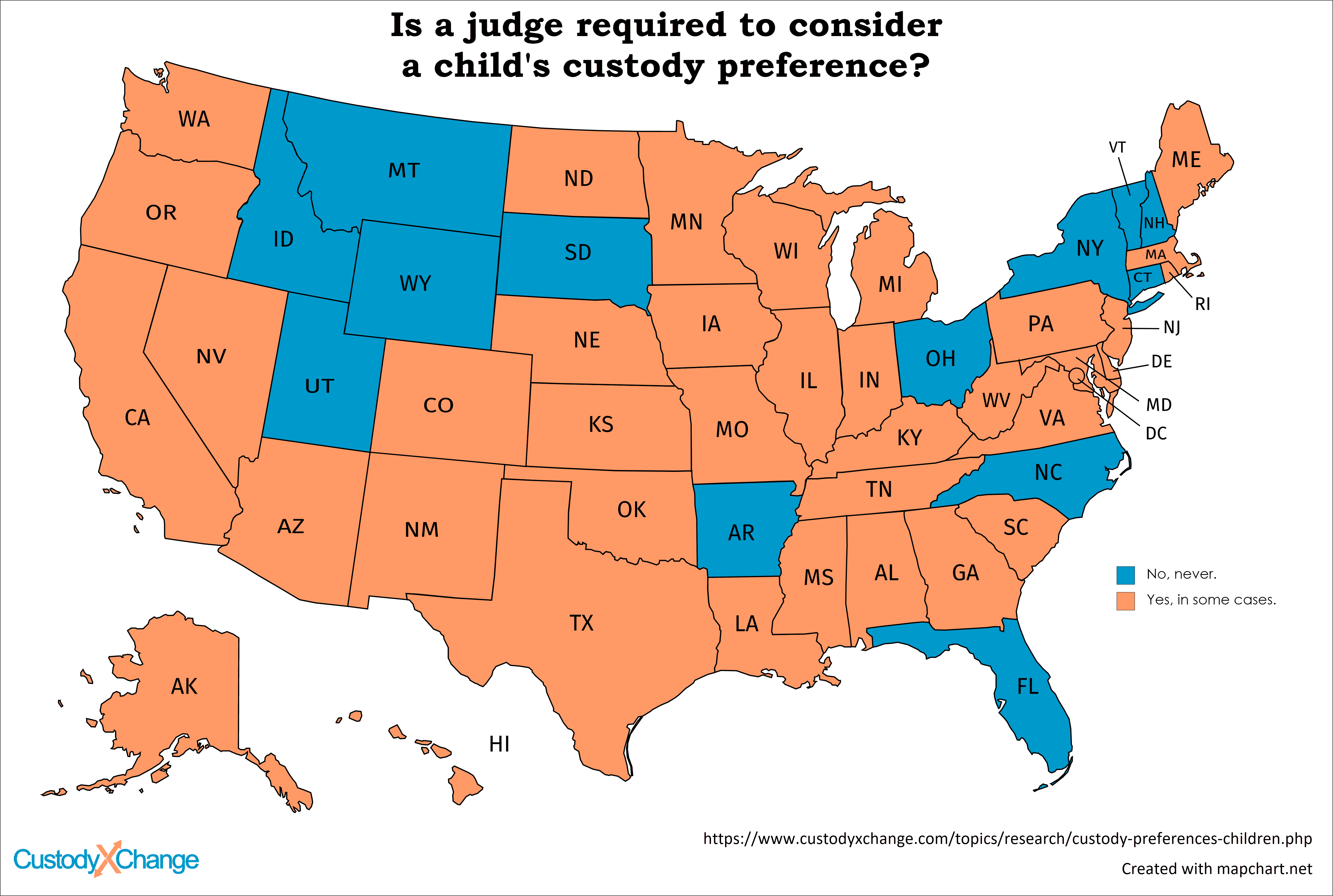
Download: PNG | JPG Utilise image with attribution
These findings come from an analysis of current state statutes by Custody Ten Change, which offers parents a web app for managing custody via parenting plans, calendars, expense tracking and more than. (Ringlet to cease for total state-by-country data.)
"If y'all go to court over custody, you need to understand your state's approach to many topics, including a child's right to share their stance," said Ben Coltrin, Custody 10 Modify co-founder and president. "There'south debate over what'due south more important: letting a child have a say or shielding them from parental disputes. How your country and judge view the outcome will affect your case."
"There'southward contend over what's more of import: letting a child have a say or shielding them from parental disputes."
-Ben Coltrin, Custody X Change president
It's important to annotation that well-nigh custody decisions are made by parents in settlement agreements; these parents can consider their child'south stance yet they want. When parents tin can't attain understanding, and then a gauge decides what custody system would serve the child's best interests.
In one case the courtroom problems a custody order, the kid must comply. This means your son or daughter cannot refuse to run into a parent who has been awarded custody or visitation time.
How quondam must a child be to weigh in?
All states permit judges to consider the preference of a child in a custody case, as long as the kid is sufficiently mature. And, as we saw higher up, a big portion of states require judges to accept a mature child's stance into account.
So when is a child mature? Most states don't set a specific historic period, instead letting judges make up one's mind case past example.
When statutes do cite an age, 14 is most common. Three states (California, New United mexican states and W Virginia) assume children 14 and older are sufficiently mature, while two (Indiana and Utah) give extra weight to the opinions of kids in this range.
Another four states (Mississippi, Oklahoma, Tennessee and Texas) presume children 12 and up are mature plenty to form a preference worth examining.
Georgia police force sets the youngest age. Information technology says children xi and up can share their thoughts with the court. (And, retrieve, Georgia kids at least 14 years old tin can cull which parent to live with, although a gauge tin override the choice if necessary.)
All these states give judges elbowroom to hear from younger children who seem particularly mature.
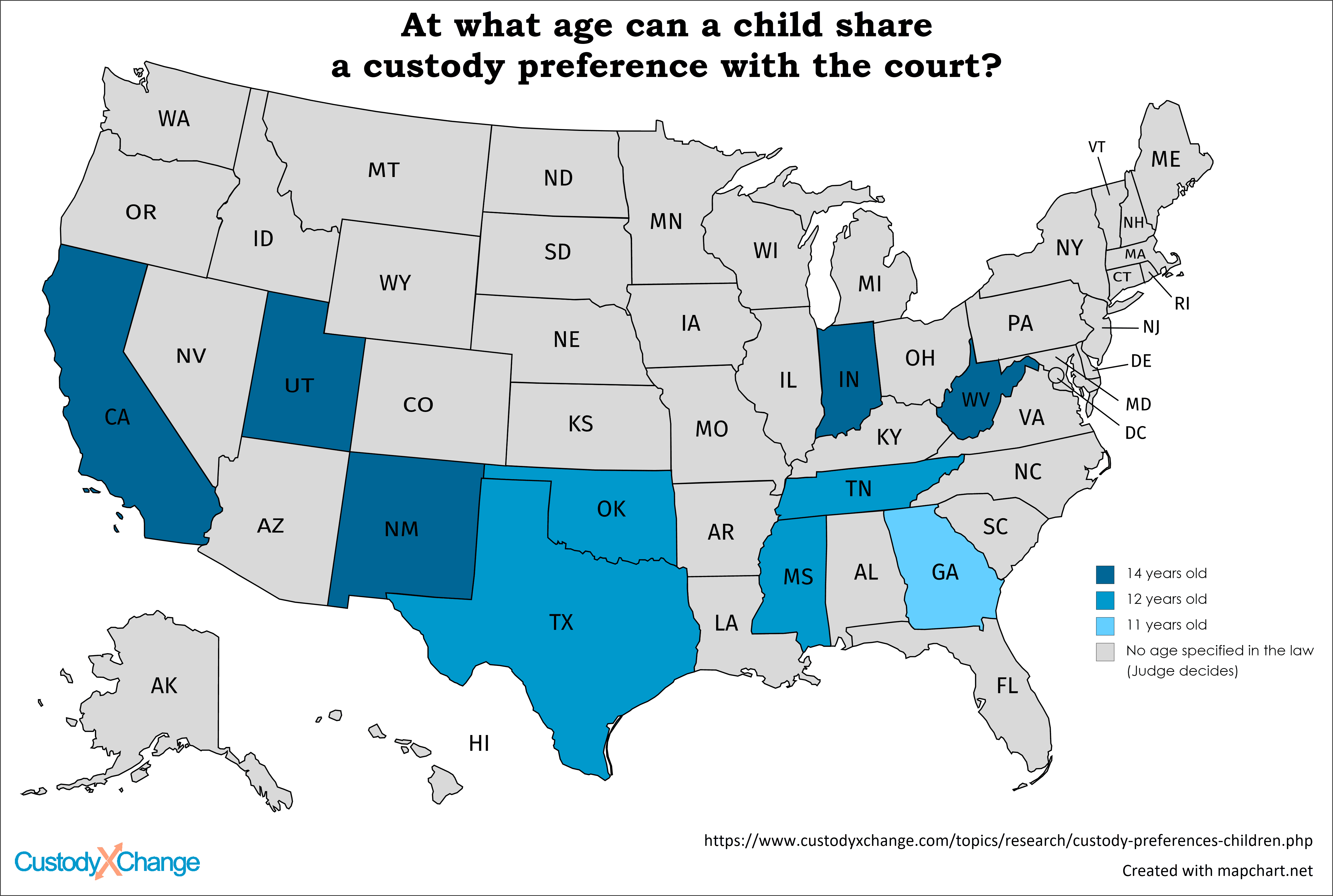
Download: PNG | JPG Use epitome with attribution
Overall, the older a kid is, the more than bear upon their wishes have on their custody example.
If your child is at least 14, a judge in any country is probable to hear what they have to say. On the other paw, a child in the unmarried digits probably won't get to weigh in. Children between these 2 groups fall in a grayness area, and whether they can provide input depends on their state, judge and maturity level.

Nationwide, children fourteen and above can usually counterbalance in on custody rulings. Children 9 and nether usually can't. The rest fall in a greyness area.
How a child's opinion fits into the large moving picture
A judge never has to award custody according to a child'south wishes. Other factors — such as each parent's criminal history and bail with the child — ever come into play.
In addition, a judge tries to assess whether a child's preference for one parent is due to persuasion or leniency by that parent, which would requite the preference less validity from the court's perspective.
For case, a 15-yr-old may non go to live with her mom as she wishes if prove shows the mother lets her drive without a license. In dissimilarity, a 12-year-old with concrete reasons for preferring a suitable parent could accept considerable influence on a judge's ruling.
How kids share their opinions
Children typically do not evidence most their preferences in court because the experience can be emotional and frightening.
Instead, they usually share their thoughts in chat with the judge, a custody evaluator or someone appointed past the court to represent their interests (like a guardian advertizing litem). In Georgia, a kid who'due south at to the lowest degree 11 can turn in a written affidavit.
Interviews with the judge accept place in the judge's office and are thus known every bit in-chambers or in-photographic camera hearings. Generally, a courtroom reporter and the child's legal representative attend. Sometimes the parents' attorneys are as well allowed in simply not the parents themselves.
Some judges ask the child direct whom they'd like to live with, while others but inquire related questions like, "What do you do for fun with your mom?" In certain states, both parents must consent earlier the child may speak with a approximate. Other factors that vary include whether parents can suggest questions for the interview and whether they can read the transcript.
State-by-state data
| State | Guess must consider a mature child's opinion? | Age guidelines in the law |
| Alabama | Aye | |
| Alaska | Yes | |
| Arizona | Yes | |
| Arkansas | No | |
| California | Yes | A child fourteen or older gets to address the courtroom, unless the court determines it's not in the child's all-time interest. A child under xiv also gets to address the courtroom if information technology'southward in their best involvement. |
| Colorado | Aye | |
| Connecticut | No | |
| Delaware | Aye | |
| Florida | No | |
| Georgia | Yes | A child xiv or older has the right to select which parent they alive with, unless a judge finds the selected parent does not serve the child'due south best interests. The judge considers the desires of a child at least 11 but not all the same xiv. |
| Hawaii | Aye | |
| Idaho | No | |
| Illinois | Yes | |
| Indiana | Yes | The court considers the wishes of the kid, with more consideration given if the child is at least fourteen. |
| Iowa | Yeah | |
| Kansas | Yep | |
| Kentucky | Yes | |
| Louisiana | Yes | |
| Maine | Yep | |
| Maryland | Aye | |
| Massachusetts | Yes | |
| Michigan | Yes | |
| Minnesota | Yes | |
| Mississippi | Yes | If the court considers both parents fit to take custody, the chancellor (judge) may consider the preference of a child 12 or older. |
| Missouri | Yes | |
| Montana | No | |
| Nebraska | Yes | |
| Nevada | Yes | |
| New Hampshire | No | |
| New Jersey | Yes | |
| New United mexican states | Yes | If the child is xiv or older, the courtroom considers their desires. If the kid is under 14, the courtroom decides custody per the child'due south best interests, considering factors like the child'due south wishes. |
| New York | No | |
| North Carolina | No | |
| North Dakota | Yep | |
| Ohio | No | |
| Oklahoma | Yes | The child gets to limited a preference if the court finds this is in the kid's best involvement. The courtroom considers the preference if the child is former enough to form an intelligent opinion. There'south a presumption a child 12 or to a higher place is old plenty. |
| Oregon | Yes | |
| Pennsylvania | Aye | |
| Rhode Island | Aye | |
| S Carolina | Yes | |
| S Dakota | No | |
| Tennessee | Yeah | The courtroom considers the reasonable preference of a child 12 or older. The court may hear the preference of a younger child. An older child's preference is normally given greater weight. |
| Texas | Aye | A child 12 or older gets to speak with the court in private. A kid under 12 may get to. |
| Utah | No | The court may consider the wishes of the kid, considering the child's maturity. The desires of a child fourteen or older get added weight. |
| Vermont | No | |
| Virginia | Yes | |
| Washington | Yes | |
| Washington, D.C. | Yes | |
| Westward Virginia | Yep | The court accommodates the preferences of a child 14 or older, if information technology'due south in the child's best interests. It besides accommodates the preferences of a younger child mature enough to express an opinion, as long equally this is in the kid's all-time interests. |
| Wisconsin | Yes | |
| Wyoming | No |
bennettfighad1967.blogspot.com
Source: https://www.custodyxchange.com/topics/research/custody-preferences-children.php
0 Response to "can children decide what house they want to live in once theyre 13 ohio"
Postar um comentário